Notice: Function _load_textdomain_just_in_time was called incorrectly. Translation loading for the acf domain was triggered too early. This is usually an indicator for some code in the plugin or theme running too early. Translations should be loaded at the init action or later. Please see Debugging in WordPress for more information. (This message was added in version 6.7.0.) in /opt/bitnami/wordpress/wp-includes/functions.php on line 6131

Notice: Function _load_textdomain_just_in_time was called incorrectly. Translation loading for the filebird domain was triggered too early. This is usually an indicator for some code in the plugin or theme running too early. Translations should be loaded at the init action or later. Please see Debugging in WordPress for more information. (This message was added in version 6.7.0.) in /opt/bitnami/wordpress/wp-includes/functions.php on line 6131

Notice: Function acf_get_value was called incorrectly. Advanced Custom Fields - We've detected one or more calls to retrieve ACF field values before ACF has been initialized. This is not supported and can result in malformed or missing data. Learn how to fix this. Please see Debugging in WordPress for more information. (This message was added in version 5.11.1.) in /opt/bitnami/wordpress/wp-includes/functions.php on line 6131

Deprecated: preg_replace(): Passing null to parameter #3 ($subject) of type array|string is deprecated in /opt/bitnami/wordpress/wp-includes/kses.php on line 2018

Medium: What If Blind People Wear a Camera That Can Detect You in Public Spaces? (by Kyungjun Lee)

Mia K. Hinckle - May 29, 2020

A research team from the UMD HCIL lab examine the social acceptance of wearable cameras.
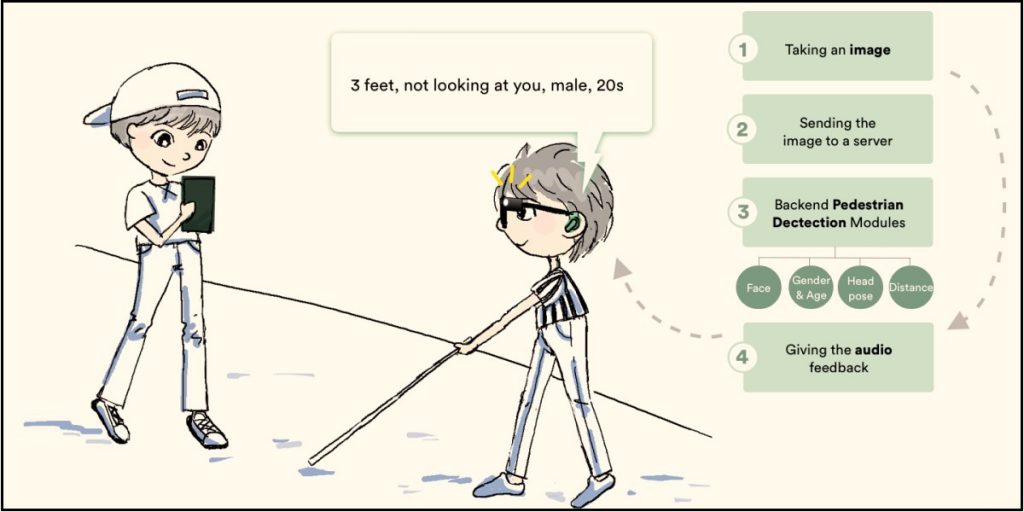
illustration of a person holding a phone and another using a white cane

In the Medium article, “What If Blind People Wear a Camera That Can Detect You in Public Spaces?” by Kyungjun Lee, Lee discuss the ethics behind assistive wearable cameras for blind people. While wearable cameras can provide blind people with the ability to detect pedestrians, this technology also raises privacy concerns.

A research team from the University of Maryland (UMD) Human-Computer Interaction Lab (HCIL) conducted an online survey and an in-person experiment to determine the social acceptance of wearable cameras. The HCIL is a multidisciplinary research lab bringing together researchers from the UMD iSchool, Computer Science, UMIACs, and more.

Lee, a UMD PhD student in Computer Science and researcher at the HCIL, shares that, “Overall, sighted participants show positive attitudes toward wearable cameras for pedestrian detection that benefit blind people. This only extends to technology where the camera is visible and the extracted information is agreeable.”

Read the full article here.